Ellsworth Street
The parish office on Ellsworth Street was two rooms behind a church with a leaking gutter, and the woman who ran it had been there since 1994 and did not like being asked questions by men in good coats.
"I can't give out addresses," she said.
"I'm not asking for an address," Elena said. "I'm asking whether she's alive."
The woman looked at her for a moment.
Then she looked at her for a much longer moment.
"Sit down, sweetheart," she said, and went into the back room and shut the door, and through the wall they heard her say a name twice.
---
Marisol Vega worked mornings in the laundry of a nursing home four blocks away and afternoons at the parish, and she had done both jobs for nine years, and she came in through the side door at twenty past two still in her work shoes.
She was forty-six.
Her hair was going gray at the front and she had a burn scar that came up out of her collar and stopped under her jaw, and she stopped dead in the doorway with her keys in her hand.
She did not look at Ross Bellweather at all.
That was the thing Elena would remember for the rest of her life — that in a room with a man she had loved and been ruined by, her mother did not spend one second on him.
"Elena," Marisol said.
Not a question.
Elena stood up and could not make any part of herself work, and her mother crossed the room and took her face in both hands, hard, the way you hold something you have been told is gone.
"They told me you burned," Elena said.
"Nobody told me anything." Her mother's hands did not let go. "That's the part I could never make anyone understand. They didn't lie to me, Elena. They just closed the file and stopped answering the phone."
She said it without heat, the way you say a thing you have already said a hundred times to people who were not listening.
"I was in the burn unit eleven days. When I got out, the apartment was gone and you were in the system and there was a form somewhere with the wrong word on it, and after that every single person I called was very sorry and nobody was allowed to tell me where you were."
---
There is a version of this story that ends in a courtroom, and for a while it looked as though it would.
Ross Bellweather's lawyers filed against the estate of the certificate itself — a fraudulent vital record, a fraudulent report to a state agency — and there was a period of eight months in which Elena learned words like tolling and equitable estoppel and sat in beige rooms answering the same question in eleven different ways.
Everett Hartnett was never prosecuted. He died in March, and the state does not try a man who cannot remember the charge.
Sloane was not prosecuted either.
Her lawyers argued that a frightened eighteen-year-old had told a lie to a housekeeper in a driveway, and that everything that came after was other people's paperwork, and in the end the record was corrected and the marriage was dissolved and she moved to Palm Beach, and that was all.
Elena found she minded less than she expected.
The thing she had wanted was never a verdict.
The thing she had wanted was a corrected line on a form.
It turned out there had been two of them the whole time, in two different counties, and nobody had ever put them side by side.
Fairfield County held a neonatal death for Infant Female Vega, filed by a physician in March of 2002. Hartford held a delayed registration of birth for Elena Vega, filed by the mother eight weeks later from an address in Bridgeport, the way you do it when you have no hospital record and no help — an affidavit, a witness, a twelve-dollar fee.
Two offices. Two drawers. Twenty-four years.
In November a clerk in Hartford issued an amended certificate and mailed it in a windowed envelope like a phone bill.
Marisol framed it.
---
Ross tried, and it was clumsy, and both of them let it be clumsy.
He offered the house first, which was the wrong thing, and Elena said no, which he took better than she expected.
What worked, in the end, was smaller.
He learned that she took her coffee with too much sugar. He learned not to send cars. He learned to text like a person and not like a memo, and one Sunday in the spring he drove himself to Bridgeport and spent four hours moving boxes into a second-floor apartment on Grand Street, and afterwards sat on the floor eating pizza out of the box with a woman who had once made him sit down on a staircase.
He and Marisol will never be anything again. She has been very clear about that, and he has stopped asking.
But he comes on Sundays.
---
Elena kept working.
Not at the agency — she took the night classes she had been putting off since she was nineteen, and paid for them herself out of stubbornness, and in her second year she started doing the intake paperwork at a family services office in Bridgeport, which is a job that consists almost entirely of reading forms very carefully.
She is extremely good at it.
Twice now she has found the wrong word on a document and refused to let it go, and both times a caseworker has told her she is being difficult, and both times she has been right.
The photograph lives in a frame on the shelf above her desk at home, next to a school picture of a nine-year-old in a plaid jumper with two tight braids.
Her mother put that one there.
"So you can see what I was looking at," Marisol said, "the whole time."
They have dinner every Thursday, the two of them, in the apartment on Grand Street, and Marisol still cannot cook anything without making enough for six people, and Elena still takes the leftovers home in a bag.
Last Thursday she got up to clear the table and her mother waved her back into her chair.
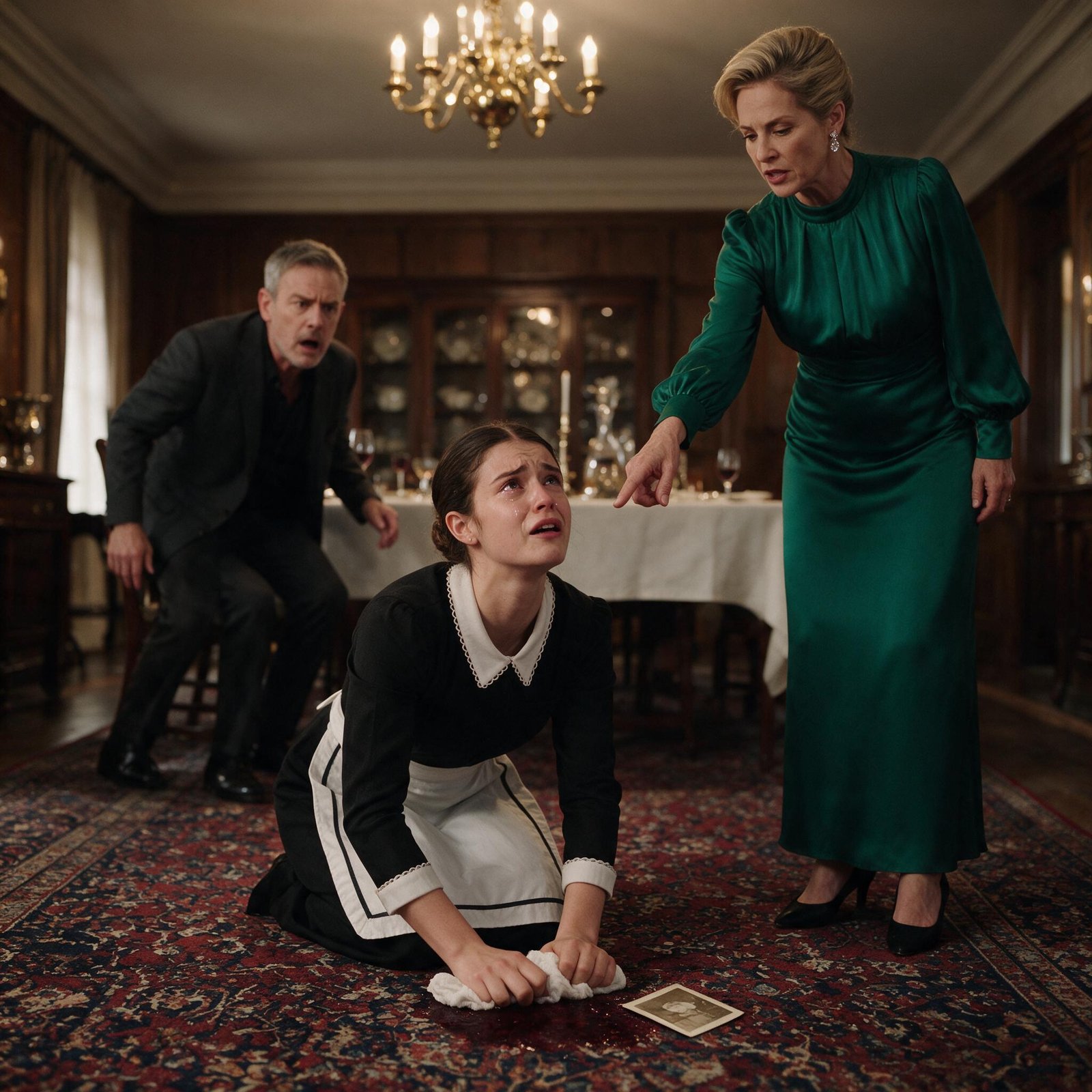
"Sit," Marisol said. "You've done enough kneeling in that family's houses."
So she sat, and let her mother do the dishes, and they left the light on in the kitchen until nearly midnight.
Part 5 of 5 · The Maid and the Photograph